Global infrastructure is undergoing a profound transformation, and Fiber-Reinforced Polymer composites have become a cornerstone material that reshapes how we build, maintain and future-proof critical structures. As a leading FRP profiles maker focused on customized solutions, we understand FRP’s key role in solving modern infrastructure problems. This article explores key trends, market dynamics and future outlook of FRP composites from 2025 to 2030 and beyond.
1.Market Growth & Drivers (2025–2030)
The global FRP composites market will grow strongly in the next decade, and this growth comes from rising demand in key industries. These industries include construction, transportation and aerospace. Market data also shows a 5.4% CAGR from 2025 to 2034, so more businesses are using FRP materials quickly. In this market, GFRP is the most popular product, and it takes up 57.9% of the market share. This is because GFRP balances low cost, high strength and great corrosion resistance, and it becomes the top choice for many projects.
This growth is fueled by several compelling factors:
- Superior Material Properties: Besides these major players in the FRP composites market, FRP composites offer exceptional strength-to-weight ratios, unmatched corrosion resistance, and long-term durability—critical advantages over aging steel and concrete.
- Cost Efficiency: Despite higher upfront costs, FRP delivers significant life-cycle cost savings by slashing maintenance expenses and extending structural lifespans.
- Sustainability Imperative: As the world prioritizes eco-friendly construction, FRP’s lightweight nature reduces transportation emissions, and its recyclability aligns with circular economy goals.
- Infrastructure Investment: Major global initiatives—from the U.S. Infrastructure Investment and Jobs Act to Japan’s urban renewal projects and Asia-Pacific’s rapid development—are driving massive FRP adoption.
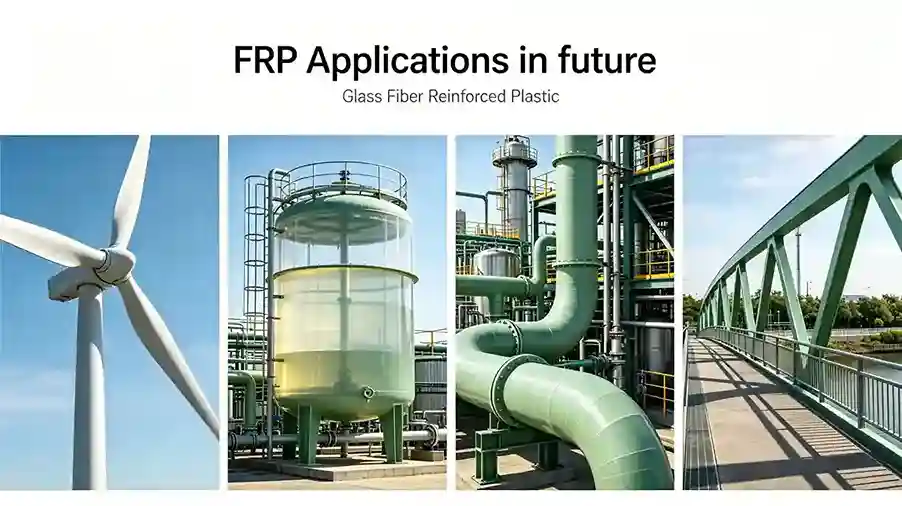
2.Key Infrastructure Applications of FRP Composites
FRP composites are revolutionizing core infrastructure sectors, with customized FRP profiles from top FRP profiles manufacturer partners enabling tailored solutions for diverse challenges.
Bridges & Structural Rehabilitation
FRP is the material of choice for replacing deteriorating steel and concrete in bridges, seismic retrofitting, and structural reinforcement. Its corrosion resistance eliminates rust-related failures, cutting maintenance costs by up to 50% and doubling service life. Customized FRP profiles deliver precision-engineered beams, columns, and rebar that fit unique bridge designs, ensuring structural integrity for decades.
Utility & Transit Infrastructure
From railway components and utility poles to coastal seawalls and drainage systems, FRP provides a lightweight, durable alternative to traditional materials. FRP utility poles resist rot, pests, and harsh weather, while transit structures benefit from quick installation and minimal upkeep. FRP profiles are integral to modular transit stations, offering design flexibility and long-term reliability.
Future-Ready Smart Infrastructure
The next frontier for FRP lies in smart, connected infrastructure. FRP profiles are now integrated into 5G smart poles, AI-monitored structural elements, and modular data centers, combining structural strength with digital functionality. These advanced applications position FRP as essential for building resilient, tech-enabled cities of tomorrow.
3.Manufacturing Innovation: Efficiency & Sustainability
The FRP industry is undergoing a manufacturing revolution, with breakthroughs boosting production and eco-friendliness. Advancements in automated fiber placement and 3D printing are set to increase production rates by 22%, enhancing precision and reducing waste. Leading FRP profiles manufacturer entities are also prioritizing recycled content integration, aligning with global sustainability targets.
Customized FRP profiles benefit directly from these innovations: automated pultrusion and molding enable complex, project-specific designs at scale, while recycled resin and fiber systems lower carbon footprints without compromising performance. This fusion of efficiency and sustainability solidifies FRP’s role as a future-ready material.
4.Sustainability & Cost: Long-Term Value
A common misconception about FRP is higher initial costs—but the long-term value is undeniable. FRP structures require minimal maintenance, avoid costly repairs from corrosion or degradation, and last 2–3 times longer than steel/concrete alternatives. Life-cycle cost analyses consistently show FRP delivers superior ROI over 30–50 years.
Environmentally, FRP is no longer just an alternative—it’s a necessity. Its lightweight design reduces material usage and transportation emissions; recyclable systems support circular economies; and resistance to chemicals/pollutants prevents environmental contamination. For sustainable infrastructure, FRP is indispensable
5.Conclusion: FRP Composites – The Future of Infrastructure
As we approach 2030, the shift from steel, aluminum, and concrete to FRP composites will accelerate exponentially. Driven by demand for resilient, sustainable, cost-effective infrastructure, FRP profiles—especially customized FRP profiles from trusted FRP profiles manufacturer partners—will lead the next construction revolution.
From iconic bridges to smart city networks, FRP combines strength, durability, and sustainability like no other material. For industry stakeholders, partnering with an experienced FRP profiles manufacturer to leverage customized FRP profiles is critical to staying ahead. The future of global infrastructure is FRP—and it’s here now.
Call to Action: Explore our full range of customized FRP profiles and connect with our expert team to discover how FRP can elevate your next infrastructure project.