

Introduction du produit
Stair stringers run along the sides of a stair flight, supporting the tread connections and transferring loads to the upper and lower supports. Their selection affects the strength, stiffness and stability of the staircase.
À propos de Mingchi FRP C Channel can be incorporated into fiberglass stair assemblies as a longitudinal side member. Its web provides a surface for attaching tread support brackets, while the flanges form part of the structural section.
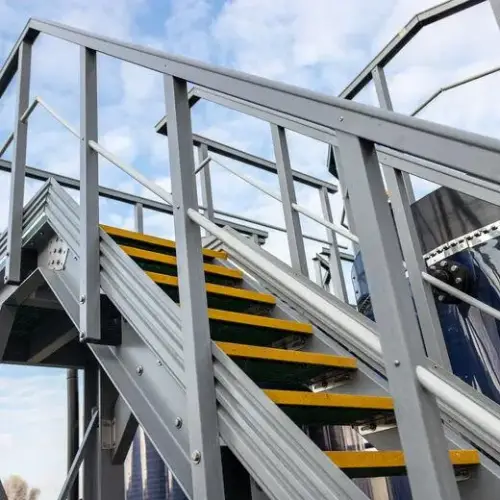
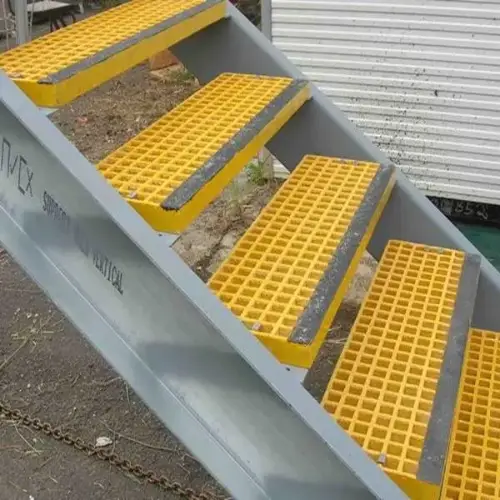
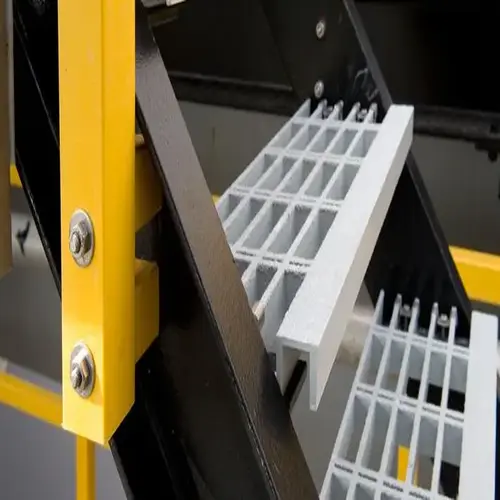
The application photos show inclined side members alongside grating treads, connected to landings and handrail assemblies. This page focuses on the channel profile supplied for the stair framework, with dimensions and fabrication details selected for each project.
Why Use FRP C Channel for Stair Stringers?
Continuous Support Along the Stair Flight
A channel stringer extends along the stair slope and connects the individual tread support points to the end supports. This makes it a key structural member of the stair assembly.
Defined Surfaces for Tread Connections
The channel web provides an attachment surface for designed brackets and bolted connections. Hole spacing can be coordinated with tread positions and the required rise and going.
Corrosion-Resistant Material Option
Fiberglass channel offers an alternative to steel stringers in moisture-exposed or chemically aggressive environments. Resin selection must match the actual exposure conditions.
Lighter Members for Handling
Compared with steel channels of the same dimensions, FRP members are lighter to handle. Final section selection must still account for differences in material stiffness and strength.
Fabrication to Match the Stair Layout
Cut lengths, end cuts and drilled-hole patterns can be specified from approved drawings, helping align the stringers with tread supports and landing connections.
Role Within the Stair Assembly
Stair Side Beams
C channels can form the inclined side beams of the stair flight. Section depth, flange width and thickness are selected according to loads, unsupported length and connection requirements.
Tread Support Connections
Treads are attached through designed support brackets or seating details. Fiberglass angle profiles may be used as local support components where specified in the drawings.
Upper and Lower End Connections
The stringers connect to a landing frame, base support or other supporting structure. End plates, brackets and anchors must be designed for the reactions at these locations.
Handrail Coordination
Where handrail posts attach to the stringers, the channel and its connections must account for the resulting loads. Explore our Systèmes de rampes en PRF for related railing options.
Typical Project Applications
Industrial Access Stairs
Side support members for stairs leading to equipment platforms, service areas and elevated walkways.
Water and Wastewater Facilities
Stair frameworks for access around treatment equipment and operating platforms, with material selection based on moisture and chemical exposure.
Chemical Processing Facilities
Channel stringers for access structures where the selected resin system suits the substances and temperatures present.
Outdoor Maintenance Platforms
Stair side members for outdoor access assemblies, with weather exposure and UV requirements specified before ordering. Explore additional FRP profile applications for industrial frames and fabricated access structures.
Technical Specifications
| Article | Spécification |
|---|---|
| Nom du produit | FRP C Channel / Fiberglass Channel |
| Main Function | Stair Stringer and Side Support Member |
| Forme de section | Open C‑Shaped Channel |
| Procédé de fabrication | Pultrusion |
| Matériau | Glass Fiber Reinforced Resin |
| Section Dimensions | Specify depth, flange width, web thickness and flange thickness |
| Member Length | According to stair layout and order requirements |
| Système de résine | Selected for the operating environment |
| Couleur | Available options to be confirmed |
| Fabrication Options | Cutting, end cuts and drilling, subject to review |
| Tread Attachment | Designed brackets or support details |
| End Connections | According to approved structural drawings |
| Structural Checks | Strength, deflection, stability and connection capacity |
| Supporting Data | Confirm required section properties and test documentation before ordering |
Selecting the Channel Section
A stair stringer should be selected using the complete stair arrangement, rather than profile dimensions alone.
The design review should consider:
- Stair flight length and inclination
- Stair width and number of stringers
- Tread spacing and attachment details
- Design loads and allowable deflection
- Lateral restraint and channel orientation
- Handrail post connections, where applicable
- Upper and lower support conditions
FRP has directional material properties. Mechanical data for the selected profile should be used when checking the member and its connections.
Fabrication and Assembly
Tread Hole Layout
Provide a drawing showing bracket positions, hole diameters and spacing. Accurate coordination helps keep the tread levels and stair geometry consistent.
End Cuts and Connections
Specify the required end angles and connection details. Confirm these dimensions against the actual landing and base support arrangement.
Handling and Installation
Support long members during handling and follow the approved installation sequence. Use suitable dust control and protective equipment for cutting or drilling.
Connection Inspection
Inspect fasteners, brackets and anchorage after assembly. Follow the specified tightening procedure to avoid damaging FRP around the connections.
Manufacturing and Inspection
Mingchi supplies pultruded FRP channel profiles to agreed order specifications.
Inspection requirements can include section dimensions, member straightness, cut lengths, end angles, hole locations and surface condition. If the stair project requires mechanical test reports or particular acceptance criteria, confirm them before production.
Why Choose Mingchi FRP?
Profile Supply Based on Your Drawings
Submit the stair layout and channel requirements so the supply scope can be clearly defined.
Coordinated Fabrication Details
Specify cut lengths, end cuts and drilling patterns for the intended assembly.
Related FRP Components
Review channel profiles alongside angle supports, railing components and grating products. For landing surfaces, explore our molded FRP grating, with panel selection based on the required span and loads.
Clear Documentation Requirements
Agree on inspection records, material data and packaging requirements before ordering.
Questions fréquentes
What is the function of an FRP C Channel stair stringer?
It acts as a longitudinal side member, supporting tread connections and transferring stair loads to the end supports.
How is it different from fiberglass angle?
The C channel can serve as the continuous stair side beam. Angle profiles are often used for local brackets, tread seating or connection details. Their exact roles depend on the design.
Can the treads be bolted directly to the channel?
The attachment method depends on the tread and stringer design. Brackets or other support details may be required; holes alone do not establish an adequate connection.
Which channel size should I choose?
Selection depends on the stair span, width, loads, restraint and connection arrangement. Send the stair drawing and design requirements for review.
Can it replace a steel stair stringer?
Replacement requires an engineering check. Matching a steel channel’s dimensions does not establish equivalent stiffness, strength or connection capacity.
Can you supply pre-drilled stringers?
Drilling requirements can be reviewed against fabrication drawings. Include hole positions, diameters and tolerances.
Does the channel make the stair surface slip-resistant?
The channel supports the staircase. Slip resistance depends on the tread surface and nosing selected for the assembly.
Demander un devis
Planning a fiberglass staircase or replacing stair side members?
Contact Mingchi FRP with your stair drawing, channel dimensions and quantity. Include the flight length, support arrangement and operating conditions so we can review the profile supply and fabrication requirements.


Chaîne de production
We produce Mingchi 80×30×3mm FRP C Channel on fully automated pultruded production lines, with stable and consistent process control throughout manufacturing. We implement strict quality inspections from raw material selection to final packaging, ensuring every channel delivers uniform quality and dependable performance for all kinds of industrial and engineering construction applications.
