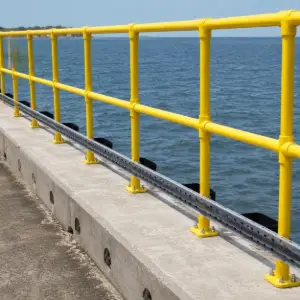
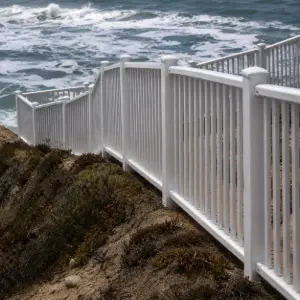
Pedestrian railing dimensions vary by standard and application. Common reference sizes include:
Standard / Application
Höhe
UK Building Regulations (buildings)
1100 mm
UK HSE guidance (non-construction)
minimum 950 mm
UK Work at Height Regulations (construction)
minimum 950 mm
British Standard 6180 (internal stairs/landings)
minimum 900 mm
British Standard 6180 (external balconies/roof terraces)
minimum 1100 mm
OSHA (US general industry)
42 inches ± 3 inches (approx. 107 cm)
AASHTO (US bridges)
minimum 3 feet 6 inches (approx. 107 cm)
CHBDC (Canada bridges)
1050–1100 mm
Typical UK commercial pedestrian guardrail
1050 mm above ground
Please note: These are reference values only. The final dimensions must be determined based on the specific project’s applicable local building codes and standards.
What is the full form of FRP in safety?
FRP stands for Fiber Reinforced Polymer (or Fibre-Reinforced Polymer). In the context of safety products, FRP is a composite material made of a polymer resin matrix reinforced with fibers (typically glass, carbon, or aramid). It is also commonly referred to as fiberglass oder GRP (Glass Reinforced Polymer)
What is the full form of FRP railing?
FRP railing stands for Fiber Reinforced Polymer Railing. It is a railing system manufactured from FRP composite materials, often also called fiberglass reinforced plastic (FRP) pipe and tube railings
What are the four general types of guardrails?
The four general types of guardrails commonly referenced for roadside applications are:
Cable with wood posts
Steel with wood or metal posts (the most common is galvanized steel W-beam guardrail)
Steel box-beam
Concrete barriers (typically installed in medians)
Alternatively, guardrails can be categorized by their deflection characteristics upon impact:
Flexible (e.g., cable barriers)
Semi-rigid (e.g., W-beam guardrail)
Rigid (e.g., concrete or steel bridge barriers)
What is the classification of a guardrail?
Guardrails can be classified in several ways:
By deflection characteristics:
Flexible – e.g., cable barriers
Semi-rigid – e.g., W-beam guardrails
Rigid – e.g., concrete barriers
By structural type (e.g., Missouri DOT standard):
Type A – single W-beam rail
Type B – double W-beam rail (for medians)
Type D – single W-beam rail with wider post spacing
Type E – single thrie-beam rail
By protection class (temporary edge protection, DIN EN 13374):
Class A – for static loads (leaning, holding, running against)
Class B/C – for static and minor dynamic loads
What are a safe pedestrian barriers?
Safe pedestrian barriers are physical barriers installed along the edges of pedestrian facilities (walkways, bridges, platforms, etc.) to prevent falls and protect pedestrians from hazards. A safe pedestrian barrier typically must:
Be of sufficient height – generally not less than 1.10 m
Have adequate structural strength – capable of resisting specified loads (e.g., as per BS 6399)
Have appropriate spacing – gaps should not allow passage of a small child (e.g., no gap allowing passage of a 100 mm sphere in UK domestic settings)
Be made of durable, low-maintenance materials – such as FRP, which does not rust or rot
What are the current guardrail standards?
Current guardrail standards vary by region and application. Key standards include:
UK / Europe:
BS EN ISO 14122-3:2016 – Fixed guardrails for machinery access
BS 6180 – Barriers in and around buildings
BS EN 13374 – Temporary edge protection
BS 13700:2021 – Permanent weighted barrier systems
Work at Height Regulations 2005 – legal requirements for fall protection
US:
OSHA 29 CFR 1910.29 – General industry guardrail requirements
OSHA 29 CFR 1926.502 – Construction guardrail requirements
A standard guardrail (or standard railing) is a barrier system erected along unprotected or exposed sides of a walking/working surface to prevent falls.
A standard guardrail typically consists of:
A top rail – smooth-surfaced throughout
An intermediate rail (midrail) – located approximately midway between top rail and walking surface
Must withstand a force of at least 200 pounds applied at the top edge
In the UK context, a standard guardrail must comply with relevant height and spacing requirements (see Q9 above), typically featuring a top rail at 1100 mm (buildings) or 950 mm (construction) with intermediate rails spaced to prevent falls
Hervorragende Produkteigenschaften
Korrosionsbeständig
Hergestellt aus hochwertigen GFK‑Materialien, um Feuchtigkeit, Chemikalien und rauen Außenumgebungen für eine langanhaltende Haltbarkeit standzuhalten.
Hohe Tragfähigkeit
Konstruiert mit verstärkter struktureller Stabilität, um schwere Lasten zu tragen und gleichzeitig Stabilität und Leistung dauerhaft aufrechtzuerhalten.
Rutschfeste Oberfläche
Die strukturierte rutschfeste Oberfläche erhöht die Sicherheit durch zuverlässige Haftung bei nassen, öligen oder stark frequentierten Bedingungen.
Einfache Montage
Das leichte und modulare Design ermöglicht eine schnelle Installation und senkt Arbeits‑ und Wartungskosten.
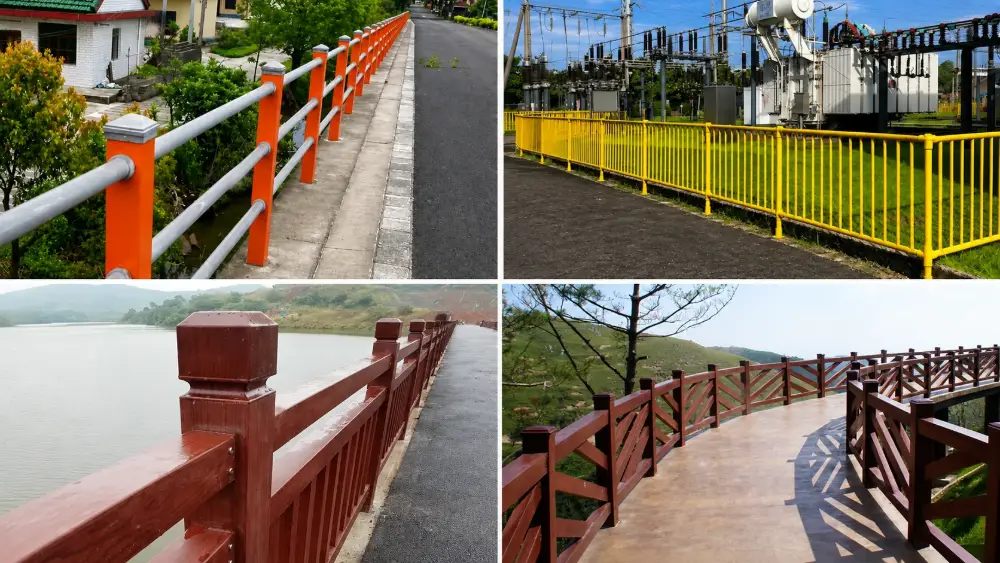
Anwendungen
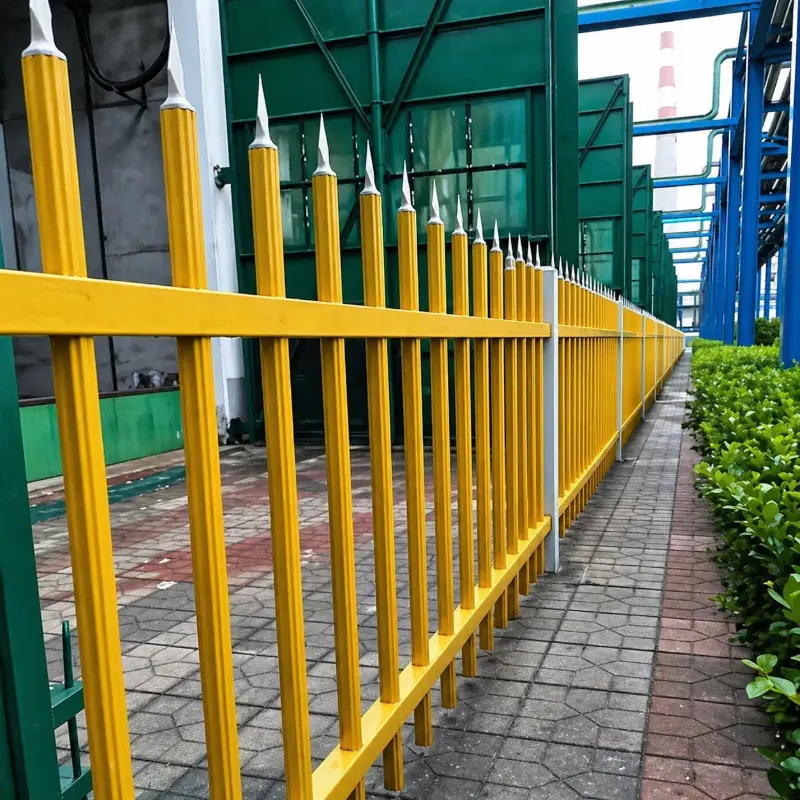
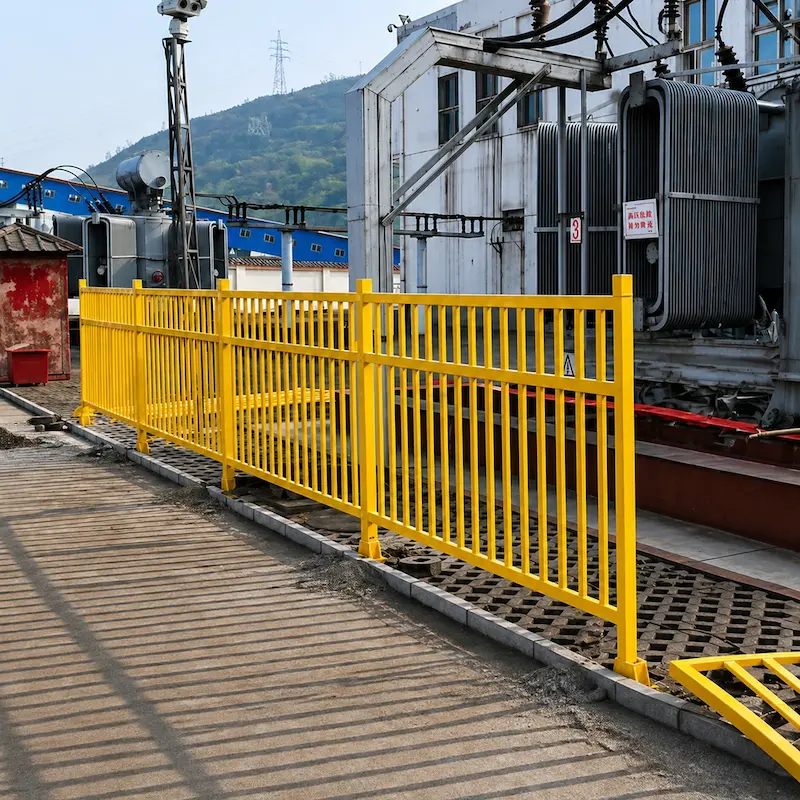
Sicherheitszaun für elektrische Anlagen
Coastal Guardrail
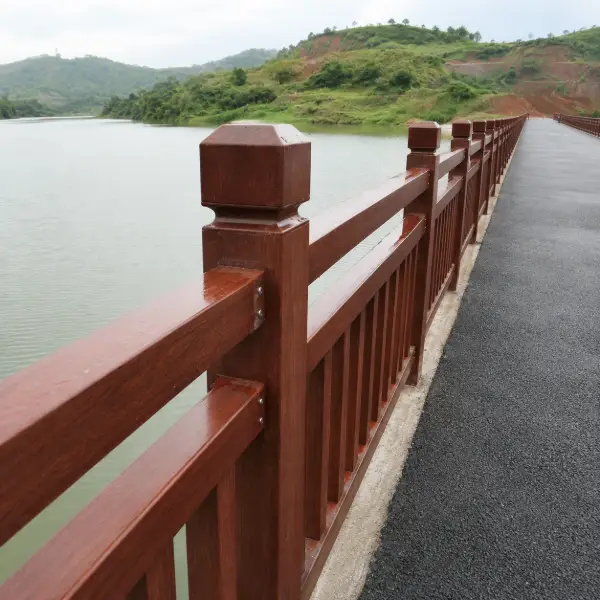
GFK-Geländer für Fußgängersicherheit
Schutzzaun aus GFK für Ölfelder
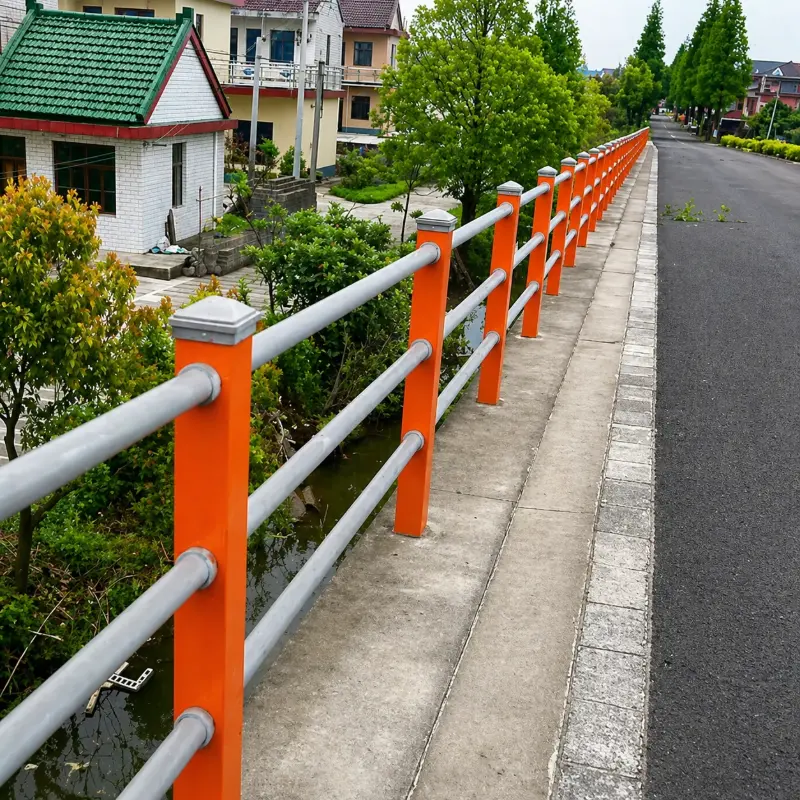
GFK-Geländer für städtische Straßen
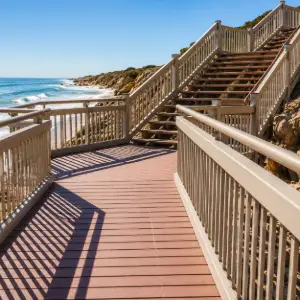
Coastal Walkway Guardrail
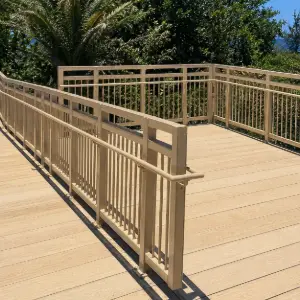
Seaside Deck Guardrail
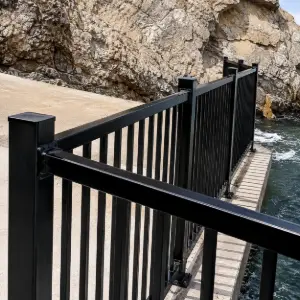
Coastal Cliff Guardrail
Pier Safety Guardrail
Seaside Guardrail
Warum uns wählen?
Korrosionsfreie Haltbarkeit
Langlebige FRP-Lösungen für raue industrielle Umgebungen.
Maßgeschneiderte Fertigung
Maßgeschneiderte Roste und Profile für Ihre Projektanforderungen.
Einfache und schnelle Montage
Leichtes Design reduziert Installationszeit und Kosten.
Vertrauenswürdiger globaler Exporteur
Zuverlässige Lieferkette und engagierter Kundenservice.
Unsere Zertifizierungen
Trusted FRP Profiles Manufacturer
Wir sind ein professioneller Hersteller mit fortschrittlichen Produktionsanlagen. Produktionslinien, strenger Qualitätskontrolle und reichhaltiger Exporterfahrung.
15000+
Fabrikfläche
20+
Produktionslinien
20+
Exportländer
20+
Jahre an Erfahrung
Erhalten Sie jetzt die Preise für GFK-Gitterroste
Nach oben scrollen
✓
Thank You for Your Inquiry!
We have successfully received your inquiry.
Our team will review your request carefully and respond as soon as possible.
If your project is urgent, please contact us directly by email or WhatsApp.